Traveling in a country where few people speak English requires patience and a sense of humor. Our interaction with locals looks very much like a game of charrades; lots of pointing, drawing, and hand symbols. Yesterday I managed to communicate with the woman at our guest house (fancy name for a room with a bed and a shower in someone's house) that a) it was just me in the room, b) I did not need a towel since I had brought my own, and c) I could hang my laundry out to dry downstairs out back. All that without speaking a word of each other's language. It is a lot of fun when you both have that 'ah ha' moment of understanding. A few days ago we played the 'what is this kind of meat' game with a woman in a very small town between Sa Pa and Lai Chau. While we were never certain what type of meat it was, we were able to determine that it had horns and it was not a dog, on account of the fact that there was a dog right beside us and she did not point to it (process of elimination). I am getting a bit sick of pho and fried rice though, which is the only thing we are able to order in restaurants that don't have a menu (most don't).
It' s been a few days without internet, so I will give a condensed version of what we have been up to. We left Sa Pa a few days ago on the 76 km trip to Lai Chau, where we went from 12 degrees and dense fog, to 26, hot and humid. On the way we climbed up and over tram ton pass, Vietnam's highest alpine pass. The ride down the other side was tons of fun, and reminded me that I love going downhill at high speeds...what a rush! The next day we did a 105 km ride from Lai Chau to Muong Lay, one of the most difficult rides any of us has ever done. The road was meant to be paved, but it turns out that 'paved' is a euphimism for 'might have some pavement on it'. We rode over gravel, dust, and pot holes while dodging huge trucks in sweltering heat for much of the day; the entire road is under construction as the Vietnamese government is installing a series of dams along the river. We arrived after dark in Muong Lay to see the sign for our hotel on the other side of the newly formed lake. We then had to bike down the hill, cross the lake on a land bridge, and then hike-a-bike up a steep gravel road to our hotel. Needless to say, we were all exhausted and covered in dirt. The story of how people's lives are changing because of this dam is another blog post entirely, but it reminds me of what is happening in northen BC with site c dam. Here in Vietnam, they are flooding the valley, relocating entire towns, and abandoning farm land. It is probably for the best, since it will provide the country with large-scale hydro electricity, but has been very interesting to see it first-hand. One thing the vietnamese are not good at...erosion countrol. Entire sides of mountains have slid as they created roads above the new water line.
Yesterday was meant to be another 90 km day, but after the 105km day from hell, we decided to forgo a rest day and split the 90km into two days. In hindsight we may have been able to pull it off; the road was in pristine condition the entire way and it was much cooler. We covered 55 km today and arrived in Dien Bien Phu before noon. We stayed last night in a guest house and had the great fortune of meeting a Vietnamese woman who spoke English. We went out to a restaurant with her and had pig's intestine. In case you're wondering, it's very chewy. Tomorrow we have opted to cover some of our 95km day by truck. Peter has arranged for two trucks to carry us and our bikes to the Laos border, saving us 35 km and a grueling 1000m climb. We still have another 60 km and 600 m climb to get us to our destination.
A few fun facts about the Vietnamese: it turns out that curly hair and a voluptuous behind are a rarity here. Women, particularly in smaller towns, like to touch (or spank) both. John is also a hot commodity with his huge flowing red beard; people stare or laugh at him, some even take photos. It makes for a great conversation starter. People hand us things (money, food, etc) with two hands, though I'm not sure of the significance and I keep forgetting to reciprocate.
Next stop, Laos.
Tuesday, March 8, 2011

Friday, March 4, 2011
Finally some photos...
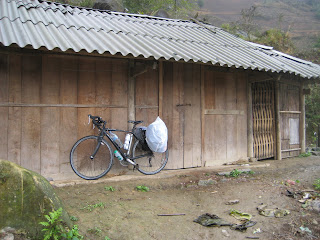
The steed, taking a break against someone's house. No one was
home.
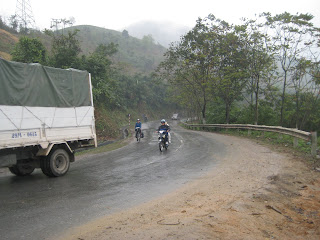
Peter being over taken by a very large truck on the way up to Sa Pa.
Our lunch stop; really just the living room of someone's house. It was a delicious meal.
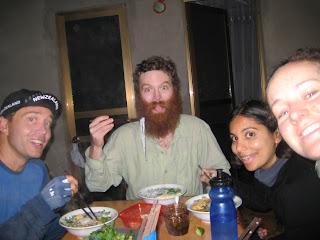
 Group shot. Opps, missed Bridget.
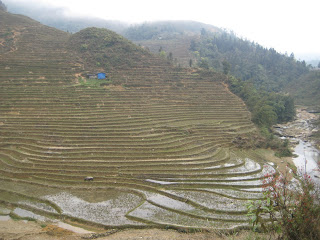
A very common view.
Local bike, complete with suspension.
 Fog.
 Taking in the breathtaking view. Imagine a huge mountain...

home.

Peter being over taken by a very large truck on the way up to Sa Pa.

Our lunch stop; really just the living room of someone's house. It was a delicious meal.
 Group shot. Opps, missed Bridget.

A very common view.

Local bike, complete with suspension.
 Fog.
 Taking in the breathtaking view. Imagine a huge mountain...

Thursday, March 3, 2011
The guide book says it's beautiful here...
...but the fog is so dense you cannot even see 1oo meters down the street. We are in Sa Pa today, taking a rest day after a long 34km slog uphill from Lao Cai. The fog is truly lovely, with a distinct 'lord of the rings' feeling. The locals think we are pretty fascinating. While they have seen tourists before, not many are silly enough to make the trek up the mountain on bikes. For a few km we had a large following of kids, who got a real kick out of walking along side us. By this stage we were not moving very fast. They laughed a lot, and I'm certain we were the butt of some very funny jokes. We stopped off in a very small town for lunch - Tak Co, pop. 12 - where we ate, you guessed it, more pho. We opted for the pho with egg option, since our phrase book does not include the question 'what kind of meat is that?'; a key question in a country that eats dog and horse. The people we meet along the way love to practice their english. We are greeted with lots of 'hello' and 'good morning!'.
Sa Pa is in north west Vietnam, and is famous for the hill trips people, particularly the H'Moung. The 'thing' to do here is to go hiking into the mountains and stay overnight at their house, where they feed you, drink rice wine with you, and generally show you a good time. Our group is torn between going on a trek to see the villages or not. A a tourist, whenever you visit a place, you inevitably change the course of their lives. Not at an individual level, but the aggregation of visitors over time alters their course. Many of these places now rely on tourism as a source of income, so the flipside is that we would be supporting their economy. We are also uneasy with the idea of going to their village and 'gawking' at them or taking photos.
Our trip out of Hanoi was definitely a highlight. We got the opportunity to navigate Hanoi traffic on our bikes, which should be a new Olympic event. The thrill of joining the chaos of traffic and surviving to tell the story was quite the rush. We all arrived at the trainstation with huge grins. Our overnight train left Hanoi around 9pm, and there were a few nervous moments when we loaded our bikes onto the cargo train and were told we could not lock them. A VERY common question asked by locals here is 'how much are those bikes?', or 'those bikes look really expensive'. I spent a few sleepless moments worrying whether our bikes would still be on the train in the morning.
Tomorrow we have a 76 km bike along what is supposed to be the most beautiful area of Vietnam, including summiting the highest mountain pass in the country. The other side of the pass is supposed to be much warmer and sunnier. Looking forward to it.
Tuesday, March 1, 2011
Pinch me, I'm in Vietnam
If you are looking for some sensory overload, come to Vietnam. People, noises, smells, foods, they have it all. Crossing the street here is like cheating death, repeatedly. There are very very few traffic signals, most intersections have nothing at all, and it is a free-for-all of motor bikes and cars weaving around each other. Lanes on the road are merely suggestions, not often followed. The trick to crossing the street is to step out, don't make any sudden moves, and walk slowly to the other side. It is surprisingly exhilarating, and so far no one has been hit.
The food is incredible, and eating has been our main activity for the last 24 hours. We are all looking forward to getting some exercise soon. The many street-side vendors look amazing, but we are still a bit worried about getting sick, so we have only eaten at restaurants that cater mostly to tourists. Today I think we will take the plunge.
A few quick lessons on travelling.
Lesson one: never order the 'vegetarian Raw' food option while flying. I had dreams that it would be some delicious raw salad or something with at least a hint of creativity. All I got was some cut up broccoli, celery, and carrot sticks. While healthy and nutritious, it left me wanting. Luckily I had some cliff bars in my carry on.
Lesson two: Really, really check your itinerary before you book it. Getting to the Vancouver airport, and then having the woman at the check in counter ask 'What would you like us to do with your luggage during the stop over?' is a shock. Um, what stop over? Turns out I had a 14 hour layover in Hong Kong. Luckily, the couple I am travelling with had some friends in HK, so they picked us up and took us to their favourite vegetarian restaurant. It was delicous! Then we a good night's sleep at their place before returning to th airport for our flight to Hanoi.
Tonight we leave on an overnight train to Sa pa, and then begin the actual bike trip with a hellish 34km ride covering 1500m of vertical. Not exactly a warm up ride. When we told our waiter last night where we were planning to go with our bikes tomorrow, he laughed. Really, really hard.
I'm excited.
P.S. Fun fact #1: The govt here has blocked networking sites like Facebook and twitter.
Tuesday, February 22, 2011
Excuse me, do you have that in organic?
I would be lying if I said I was not a little nervous about my trip to Laos, but not for the reasons you may think. I'm not nervous about getting lost, or injured, or having all my things stolen; I have no where I need to be, I'm tough, and the only thing I am bringing is my bike and the clothes on my back. I'm also not nervous about language issues or bike malfunctions; I know how to point and am going with friends who make my bike mechanic look like a beginner. As an aside, it turns out my bike mechanic is a pretty witty guy. When I dropped my bike off for repairs this week and told him I needed a new part, he pulled out the holy grail of catalogues, pointed to the part that was labeled 'Galaxy', and said, 'We'll get you this one because it will work everywhere.' I stared at him blankly, at which point he said, ' it was a joke', and then I laughed. I could write an entire post on 'how to tell if you're bike mechanic is hitting on you (you can't), and what do to about it (act smarter next time)'.
Being a big supporter of all things to do with food (okay a 'foodie'), what has truly been on my mind this last week is the sort of food system that exists in Laos. Did that chicken live a good life? Was that mango grown without pesticides? Can I eat that and not die? Virtually everyone I have spoken to has told me I will get sick and/or lose 10 pounds the first week I am there. Who doesn't want a smaller ass, but I'm less keen on puking off the side of my bike for 2 days. In Canada we are very lucky (read spoiled) to have supermarkets jammed full with every imaginable fruit, vegetable, dead thing, and corn-derivative-masquerading-as-food on the shelves. Vancouver in particular is blessed with more organic food choices than all other cities combined (don't quote me on that, I made it up).
The key point here is, we have choices, and lots of them. We can choose organic, non-organic, local, pesticide-laden or pesticide-free. Choice over what we put into our bodies feels to me like a fundamental right, but it is one that many people don't have. Much of the world population does not get a choice about what they eat that night for dinner (if they eat at all), where it came from, and how it was grown. This is environmental justice, or a lack of it. Some of us can afford to purchase healthy options, while others are not even given the choice, or if they are they cannot afford it. It is therefore up to us, those of us who have the choice, to make the right one. As demand grows for organic food systems, so to does the supply, so every ethical and sustainable purchase you make is moving us one step closer to a more sustainable agriculture system. Choose food that was grown organically, humanely, and supports local farmers where possible. If you have the choice, exercise it for all those who can't.
Tuesday, February 1, 2011
getting old, or not
Once a week there are a group of men who gather near my house to play football, or rather, toss a football around. When I first came across them I thought they were practicing some sort of drill in slow motion, but then I realized, 'That's as fast as they run; they're 80.' They appear to be having a lot of fun, though no one is moving faster than a snail, or as one witty friend put it recently, 'like turtles stampeding through peanut butter'. The visual image of that makes me laugh every time.
I like to imagine what sort of lives they have led, and how they arrived at 80, fit and still enjoying life. I have them pegged as part of the 1943 UBC Varsity football team, married to their high school sweethearts. Lucky ladies. I hope my guy (mythical at this stage) is half as virile as them when he's 80. I also think they genuinely get a kick out of running around catching the football (I know I sure do) and enjoy it when others watch them, if only for the security of knowing that someone can call 911 when something fails. They are the 80 yrd old versions of the guys you know today who go to every practice, suck up an injury, and think that all great parties happen in the locker room. These men are dedicated to their passion, even at this late stage, and appear to be committed to staying active doing something they love.
I recently took the greyhound bus to Revelstoke (an eye-opening experience if you're looking for one), and along the way I met a lovely older man who sat behind me and shared stories until Salmon Arm. He was adventurous, loved to travel, had some great and funny stories about his run-ins with the border guards, and had to be pushing 80 years old. He talked about the little community he now lives in, and even though he had only been there for a year (moved from the coast to get away from the dampness; it bothered his breathing) he had an entire network of friends who took care of each other, and a family who live next door with kids who treat him like a grandfather. As he got off the bus in Salmon Arm, the last thing he said to me was 'don't get old'. I smiled and promised him I would not.
Wednesday, January 26, 2011
Finding balance...
A recurring theme keeps showing up in my life - women - so I am taking the hint and have decided to write something about it. Usually I start off writing a blog knowing exactly what I want to say, where humor can be injected, and how it will end. This time you know as much as I do, so let's get writing...or reading...
A few years ago I picked up a book at the UBC book store called 'Women and the Gift Economy'. It was my first foray into women-specific (read feminist) literature, and I was really moved by the idea that women offer a very unique perspective and set of values to the world. The idea of a gift economy, one based not on exchange but on giving freely whatever we could, really spoke to me. Giving something without any expectation of a return is a vastly different experience to 'exchanging' something, as we can all attest to. When a gift is given, its value continues long after the act has taken place, for both the giver and the givee. Yet with an exchange, the value of the gift is cancelled in the act of exchanging. Gift giving is based on offering what you can, while exchange is measured by what you have. One creates a sense of wealth, while other a sense of scarcity. Unfortunately I never made it all the way through the book; it was so dense and read more like a 4th year women's studies text book.
Last week I ventured to the book store, hoping to find something I could read to offer a new perspective on life, and came home with not one but four books. One of the books, 'Staying Alive', discusses women's inherent role as protectors of the environment and producers of much of the worlds food...that is until recently. The loss of knowledge, seed saving, and other important factors of sustainable agriculture are tied directly to womens' rights, or lack of, according to the book. For thousands of years women have been the nurturers of family and food; gathering, harvesting, and passing on knowledge of plants. Staying Alive points the finger directly at white, Caucasian males for the erosion of this traditional knowledge and the privatization and patenting of nature and indigenous knowledge. While I firmly believe that this is indeed happening around the world, I found the finger pointing distracting from the more important messages, and finally had to put the book down. My hope is that feminist viewpoints could be about celebrating women's role, not blaming the other gender for all that has gone wrong.
Flash forward to today; I came across an article that was truly a breath of fresh air on women's perspectives in sustainability. Ironically, it was written by a man. The article, titled 'The Essential Role of Women in a Restorative Future", discusses the need for gender balance in our communities, decisions, and boardrooms. There is no blaming or finger pointing, rather simply an acknowledgment that a lack of female representation in many areas has gotten us to our current situation. The author articulates that men, like women, don't have all the answers, but together we do. Analogous to your right and left brain, the two halves work together to produce the whole.
Subscribe to:
Posts (Atom)